


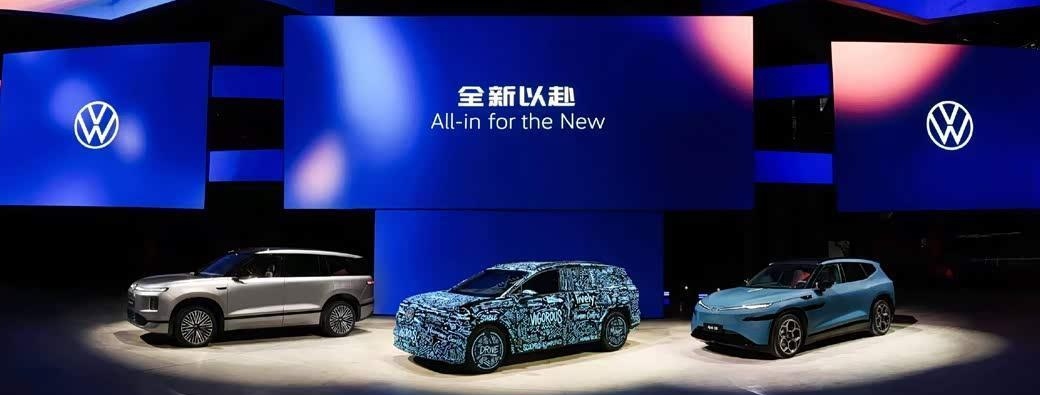
Chinese automakers should take note: the German competition is fighting back. In early April, Volkswagen showcased three brand-new models—the ID. UNYX 08, ID. ERA 9X, and ID. AURA T6—at its Brand Night event. This marks the completion of the first phase of Volkswagen’s massive electrification offensive in China, signaling that the “In China, for China” strategy has officially entered the delivery stage.
To demonstrate the brand’s determination in the Chinese EV market, Thomas Schäfer, CEO of the Volkswagen Passenger Cars brand, repeatedly emphasized being “All In” and “fully committed.”
According to Volkswagen’s roadmap, the brand will launch 13 new energy vehicle (NEV) models in China by 2026, covering pure electric (BEV), plug-in hybrid (PHEV), and extended-range electric vehicles (EREVs). By 2027, NEVs are expected to account for more than half of the brand’s product portfolio. By 2029, the number of new NEV models in China will exceed 30.
### Delivering Results for the Chinese Market
Volkswagen is undoubtedly the most successful joint-venture brand in China. As of April 2026, they have attracted over 47 million users in the country, ranking first among all automotive brands. However, in 2025, Volkswagen’s sales in China fell below 2 million units—a sharp decline from the over 3 million units sold just six years prior. This 35% drop is primarily attributed to the rapid shift toward electrification.
In the EV era, Chinese brands have seized the lead by leveraging a mature smart-tech supply chain and rapid iteration speeds. After reflecting on these challenges, Volkswagen decided to stage a comeback by partnering with leading local Chinese companies.
“Volkswagen is a global brand, but we highly value regional market needs, especially in China,” said Thomas Schäfer. “We have given the Chinese team full autonomy and decision-making power to play a more significant role.”
With increased authority for the local team, Volkswagen has gained greater flexibility in powertrain options. Beyond BEVs and PHEVs, the brand is now developing EREVs with a comprehensive range exceeding 1,600 kilometers (approx. 994 miles). Furthermore, the design language for localized products has become more distinct.

To stay at the forefront of smart EV technology, the Volkswagen Group China Technology Company (VCTC) has recruited over 3,000 engineers. Volkswagen is also integrating the strengths of local partners with its own core competencies.
The focus isn’t just on NEVs; internal combustion engine (ICE) models are also receiving upgrades. According to Dr. Robert Cisek, CEO of Volkswagen Passenger Cars China, the CEA (China Electronic Architecture) developed in collaboration with Xpeng will eventually be expanded to ICE models. This architecture provides a solid technical foundation for VW’s future in China, driving the brand toward a new era of intelligent connectivity.
Regarding sales channels, the ID. UNYX 08 will be integrated into the FAW-Volkswagen network. Dr. Cisek noted that the ID. UNYX sub-brand will launch more models, utilizing the mature dealership networks established over decades to quickly scale these new products.
### Preserving the Brand’s “Soul”
While accelerating in China, Volkswagen also plans to launch nine new BEV models in Europe by the end of 2027 and 11 new models in South America by the end of 2028. Schäfer emphasized that their goal is to democratize high technology across all segments while maintaining the global Volkswagen DNA: safety, quality, and reliability.
Dr. Cisek added that the goal is to combine “German Craftsmanship” with China’s innovative ecosystem. Volkswagen does not believe that seeking partnerships in the smart EV space means “losing its soul.” Instead, they view collaboration as essential for building superior products.

Schäfer believes VW’s advantage lies in its ability to integrate technology effectively into the vehicle to enhance the user experience, a skill honed over 40 years in China and even longer globally. Dr. Cisek compared the relationship with partners like Xpeng, Horizon Robotics, and CATL to “cooking.” While high-quality ingredients (technology) are essential, the final dish depends on the chef’s ability to integrate and tune those components.
Unlike some Chinese brands that focus on “stacking” features, Volkswagen aims to provide functions that offer real value. By analyzing data from tens of millions of users worldwide, VW continues to iterate and optimize its systems for maximum usability and smoothness.
### Staying on the “Dance Floor”
In 2025, China’s auto market hit a record 34.4 million units, with NEVs surpassing 16 million units—nearly a 50% market share. However, profit margins in the industry dropped to a historic low of 4.1%.
In such a hyper-competitive market, some global giants might choose to wait for the “price war” to settle before re-entering. Volkswagen rejects this strategy. Dr. Cisek compared the market to a dance floor: “If you step off the dance floor and stop dancing, you might not be able to find your rhythm when you try to come back for the next song.”
Schäfer acknowledges that brand value alone isn’t enough; VW must offer substance, including cutting-edge tech and cost efficiency. “Localization is the only way to remain competitive in China,” he stated. Moving forward, the synergy between German and Chinese teams will continue, with the German side learning from China’s speed and efficiency, while the Chinese side benefits from VW’s deep engineering heritage.
As we look toward 2026, the arrival of the ID. UNYX 08, ID. ERA 9X, and ID. AURA T6 will show just how well this “more Chinese” Volkswagen can dance on the world’s most competitive EV stage.


