


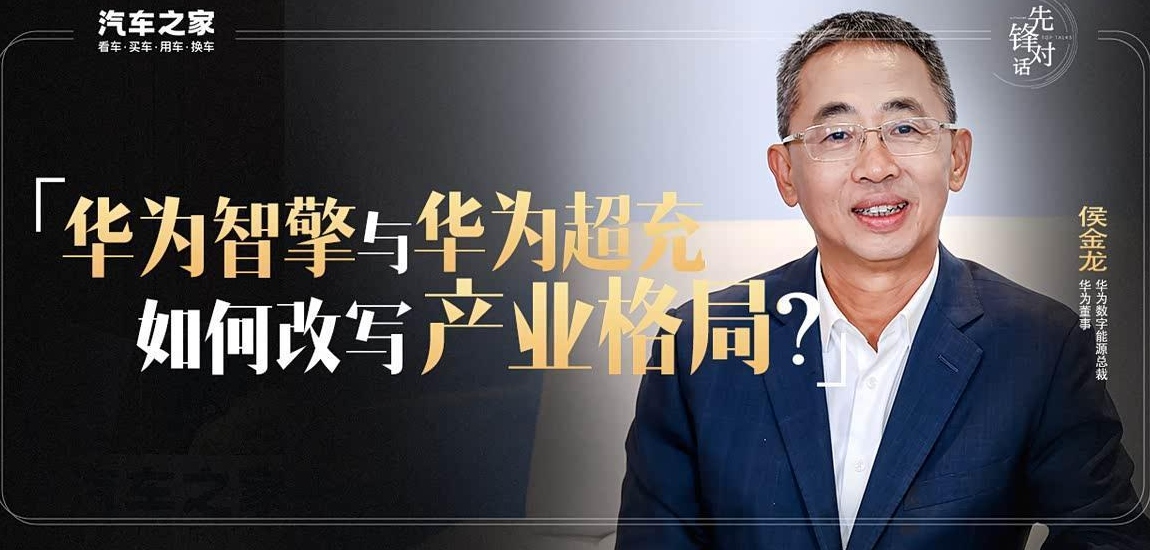
On April 23, 2026, ahead of the Beijing International Auto Show, Hou Jinlong, Director of Huawei and President of Huawei Digital Power, officially unveiled “Huawei Zhiqing,” the new Chinese brand for HUAWEI DriveONE. During the event, he also announced Huawei’s comprehensive supercharging strategy and a new lineup of products designed for both passenger and commercial vehicle scenarios.
In a post-launch discussion, Hou emphasized two core pillars for the future of China’s New Energy Vehicle (NEV) industry: “Motion Domain Intelligence” and “Megawatt Supercharging for Heavy Trucks.”
### Motion Domain Intelligence: The Final Piece of the Electrification Puzzle
After more than a decade of development, the NEV industry is entering its “third wave,” characterized by quality upgrades, full-scenario coverage, and global competition. While passenger vehicle penetration has surpassed 50%, commercial vehicles remain stagnant in closed environments. Huawei aims to break this deadlock.
Hou Jinlong pointed out that the industry’s definition of “electrification” has been too narrow, focusing only on replacing engines with motors and fuel tanks with batteries. “To support the rapid response required by high-level autonomous driving (L3 and above), simply having an electric drive is not enough,” Hou stated. “The entire motion domain—including braking, steering, and suspension—must be fully electrified.”
This is the logic behind the “Huawei Zhiqing” brand. Unlike traditional suppliers who focus on individual components, Huawei is shifting from “super components” to “super systems.” Huawei Zhiqing integrates drive, braking, steering, and suspension into a unified XYZ three-dimensional space fusion control model. This deep synergy reduces single-wheel control cycles by 50% and improves control precision by 50%.

Technologically, Huawei Zhiqing’s new dual 94% Silicon Carbide (SiC) power platform has set industry records for efficiency in both range-extended and pure electric modes. Vehicles equipped with this system can achieve an efficiency of “12 kilometers per kilowatt-hour.” Furthermore, the wire-controlled electronic braking system boasts a response time of just 78ms, a tenfold improvement over traditional hydraulic systems.
As of April 2026, Huawei Zhiqing has shipped over 2.4 million units, with a cumulative mileage exceeding 40 billion kilometers, maintaining a top-tier safety and quality record.
### Megawatt Supercharging: Solving the Commercial Vehicle Deadlock
While “Zhiqing” addresses the vehicle’s internal performance, Huawei’s supercharging strategy tackles the external challenge of energy replenishment. Hou identified heavy-duty trucks as the next major growth engine for electrification.
“Heavy trucks account for only 3% of vehicle ownership but contribute 54% of road transport carbon emissions,” Hou noted. The primary bottleneck has been charging. Traditional slow charging takes over an hour to provide 300-400km of range, which is unacceptable for long-haul logistics. This has created a “vicious cycle” where lack of infrastructure prevents vehicle adoption, and lack of vehicles discourages infrastructure investment.

To solve this, Huawei introduced its Megawatt-level supercharging solution. This system supports charging rates from 1C to 3.5C+, covering all heavy truck scenarios. For a 50-ton heavy truck, the operational cost of diesel is approximately 2.7 to 2.8 RMB (approx. $0.37 to $0.39) per kilometer. With Huawei’s Megawatt supercharging, the cost drops to 1.2 to 1.5 RMB (approx. $0.17 to $0.21) per kilometer, significantly boosting profitability for logistics companies and operators.
Addressing concerns about the grid impact of high-power charging (a single truck can require 400-500 kWh with currents up to 2400A), Huawei treats each station as a “micro-grid,” integrating it as a high-quality node within the modern power system.
### Innovation and Ecosystem Collaboration
Huawei remains committed to its “not building cars” boundary, acting instead as a technology partner to help automakers build better vehicles. The Huawei Supercharging Alliance, established in 2024, now includes major players like Beiben Heavy Duty Truck, Dongfeng Commercial Vehicle, XCMG, and Sinotruk.
By 2026, Huawei and its partners have deployed supercharging networks across more than 400 cities in China. Hou concluded that in an era of intense cost competition, Huawei will continue to prioritize quality, performance, and safety, providing the underlying technology to ensure a win-win future for the global NEV ecosystem.


